
27 - Ummendorf Castle
From aristocratic residence to museum
The Börde Museum at Ummendorf Castle
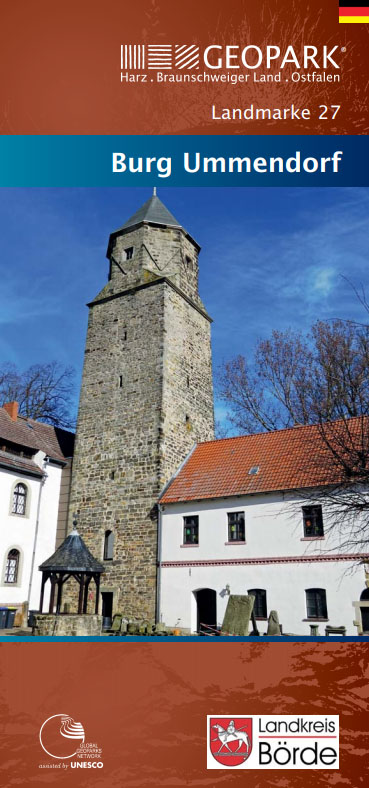
Ummendorf Castle was first mentioned in writing in 1363 in the land peace document of Archbishop Dietrich of Magdeburg. However, the lower storeys of the castle tower date back to the second half of the 12th century. The complex was constantly adapted to the needs of the "inhabitants" through alterations. Traces of the defence system from the late Middle Ages - consisting of a defensive wall and corner towers - are still visible today. In the 16th century, the castle was remodelled in the style of a Renaissance castle. Until 1667, the lords of Ummendorf Castle were noblemen. When the last lord of the castle died without descendants, the office was converted into a domain. From then on - until the estate was dissolved in 1912 - the grounds and administration were under the control of bourgeois tenants. Acquired by the municipality in 1919, the castle has housed a school in the southern part and the
cultural-historical regional museum of the Magdeburger Börde, a landscape with fertile black earth soils.
The development of agriculture and rural life are at the centre of the exhibition, with the way country people lived 200 years ago staged in the interior rooms. Grain processing equipment and machinery bear witness to the importance of the Börde as Magdeburg's granary. The outdoor area with its agricultural exhibition and herb garden, which displays over 400 different useful plants, is a magnet for visitors. From the castle courtyard, visitors can access a small show mine, which refers to the history of potash and rock salt mining in the region. The exhibits in the castle courtyard itself provide information about the local rough sandstone and its processing and form another of the museum's Geopark themes.
Click here and find out all the details about the Ummendorf Castle landmark.
From aristocratic residence to museum
The Börde Museum at Ummendorf Castle
Ummendorf Castle was first mentioned in writing in 1363 in the land peace document of Archbishop Dietrich of Magdeburg. However, the lower storeys of the castle tower date back to the second half of the 12th century. The complex was constantly adapted to the needs of the "inhabitants" through alterations. Traces of the defence system from the late Middle Ages - consisting of a defensive wall and corner towers - are still visible today. In the 16th century, the castle was remodelled in the style of a Renaissance castle. Until 1667, the lords of Ummendorf Castle were noblemen. When the last lord of the castle died without descendants, the office was converted into a domain. From then on - until the estate was dissolved in 1912 - the grounds and administration were under the control of bourgeois tenants. Acquired by the municipality in 1919, the castle has housed a school in the southern part since 1924 and the regional cultural history museum of the Magdeburger Börde, a landscape with fertile black earth soils, in the northern part. The development of agriculture and rural life are at the centre of the exhibition.
The interiors show how the country people lived 200 years ago. Grain processing equipment and machinery bear witness to the importance of the Börde as Magdeburg's granary. The outdoor area with its agricultural exhibition and herb garden, which displays over 400 different useful plants, is a magnet for visitors. From the castle courtyard, visitors can access a small show mine, which refers to the history of potash and rock salt mining in the region. The exhibits in the castle courtyard itself provide information about the local rough sandstone and its processing and form another of the museum's Geopark themes.
Click here and find out all the details about Ummendorf Castle.
© 2020 Geopark Harz . Braunschweig Land . Eastphalia
 English (UK)
  Deutsch
  Español
  Français
  Italiano
  Dansk
Dansk  Nederlands
  Português