
23 - Werla Imperial Palace
A journey into the Middle Ages
The Ottonian Palatinate has always been associated with the names of great kings of the early Middle Ages. They travelled through the country with large retinues, dispensing justice and deciding on war and peace. The Palatinate of Werla
was one of their most important bases in eastern Saxony. After the walls and ramparts fell into disrepair, its location was forgotten for centuries. But hidden beneath the striking hilltop on the Oker river
its foundation walls and foundations have been preserved. When they were rediscovered, the unaltered findings caused a sensation both in
the general public as well as among experts.
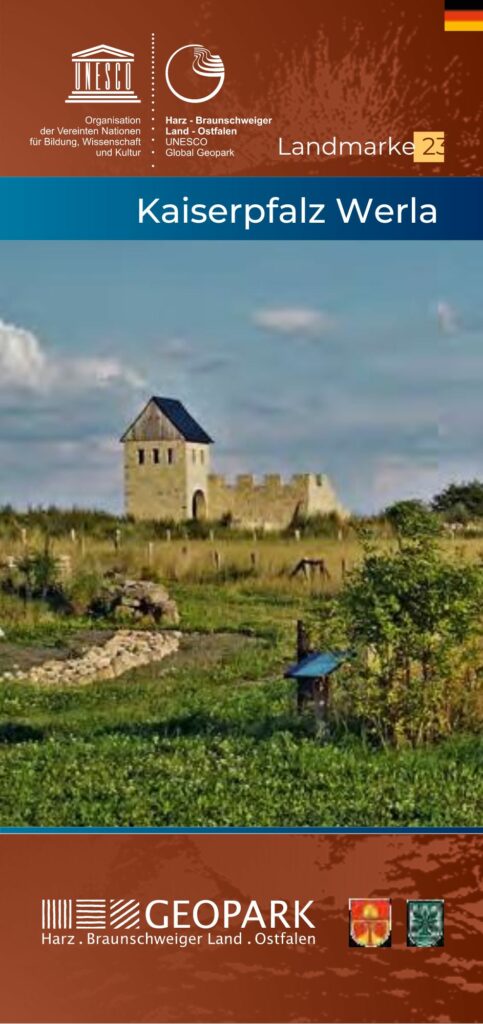
New finds provide information on how the palace developed into a settlement in the High Middle Ages and experienced an economic heyday. Visitors to the site can now also get an idea of the former dimensions of the palace complex. The foundation walls have been reconstructed for the "Werla Imperial Palace Archaeological and Landscape Park" and the course of the walls has been made visible again by means of ramparts. At the same time, work began on renaturalising the area in order to connect the historic site with the extraordinary natural environment.
Click here and find out all the details about the Werla Imperial Palace landmark.
A journey into the Middle Ages
The Ottonian Palatinate has always been associated with the names of great kings of the early Middle Ages. They travelled through the country with large retinues, dispensing justice and deciding on war and peace. The Palatinate of Werla
was one of their most important bases in eastern Saxony. After the walls and ramparts fell into disrepair, its location was forgotten for centuries. But hidden beneath the prominent hilltop on the River Oker, its foundations and foundations have been preserved. When they were rediscovered, the unaltered findings caused a stir among the general public and experts alike.
New finds provide information on how the palace developed into a settlement in the High Middle Ages and experienced an economic heyday. Visitors to the site can now also get an idea of the former dimensions of the palace complex. The foundation walls have been reconstructed for the "Werla Imperial Palace Archaeological and Landscape Park" and the course of the walls has been made visible again by means of ramparts. At the same time, work began on renaturalising the area in order to connect the historic site with the extraordinary natural environment.
Click here and find out all the details about the Werla Imperial Palace landmark.
© 2020 Geopark Harz . Braunschweig Land . Eastphalia
 English (UK)
  Deutsch
  Español
  Français
  Italiano
  Dansk
Dansk  Nederlands
  Português