
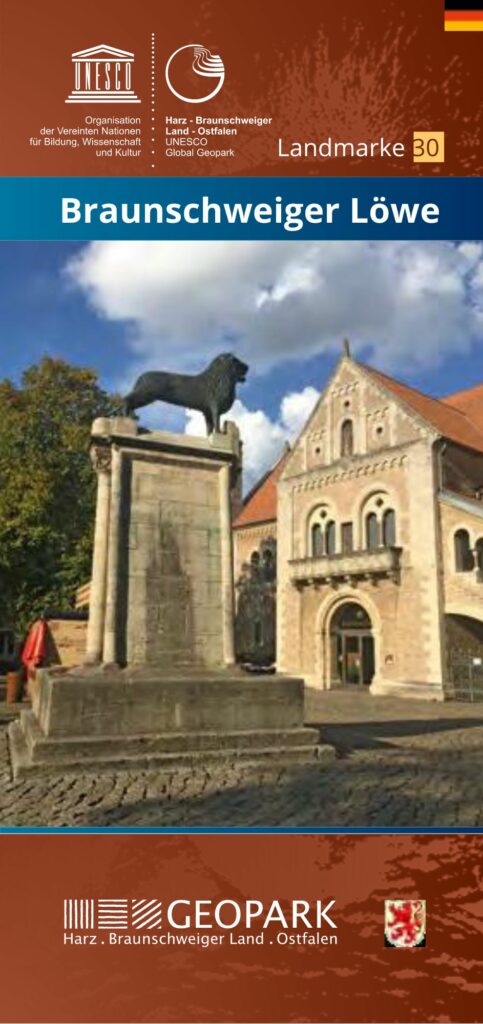
30 - Brunswick Lion
Around the Braunschweig lion on the Burgplatz
In addition to the castle and cathedral, the Braunschweig State Museum (originally the
Vieweg Verlag), the Huneborstel House and the Veltheim House. The central point of the castle square is the statue of Henry the Lion. Created around 1166, the east-facing lion is the symbol of Henry the Lion and symbolises the city's jurisdiction. Today there is a copy on the Elm limestone pedestal, while the original is preserved a few tens of metres away in Dankwarderode Castle. To the south-west behind the cathedral are the canons' houses from the 15th century. Today's modern paving of the castle square is made of Beucha porphyry and some Lusatian granite, both rocks from Saxony.
The former collegiate church of St. Blasii on the southern
side of the Burgplatz is now a Protestant-Lutheran church.
Cathedral. The church was built by Henry the Lion
after returning from his pilgrimage to Palestine in
The church was built between 1173 and 1195 as a three-aisled pillar basilica.
Henry was buried here next to his wife Mathilde in 1195. It is also the burial place of Henry's son Otto IV, German emperor and king,
is located in the cathedral. Initially built as a three-aisled
Basilica has been rebuilt several times to this day.
rebuilt, extended and reconstructed. For the
Elm limestone and red limestone were used for the masonry.
Braunschweig Rogenstein. In addition, the
North portal of the cathedral also Helmstedt rhomboid sandstone
which used to be mined in numerous pits in the Lapp Forest.
was extracted. Elm limestone was also used to
plinths, wall corners, door and window reveals and
Heinrich's tomb was erected. The paving slabs
Click here and find out all the details about the Braunschweig Lion landmark.
In addition to the castle and cathedral, the Braunschweig State Museum (originally the headquarters of the Vieweg publishing house), the Huneborstel House and the Veltheim House are grouped around the Braunschweig Lion on the Burgplatz. The centrepiece of the castle square is the statue of Henry the Lion. Created around 1166, the east-facing lion is the symbol of Henry the Lion and symbolises the city's jurisdiction. Today there is a copy on the Elm limestone pedestal, while the original is preserved a few tens of metres away in Dankwarderode Castle. To the south-west behind the cathedral are the canons' houses from the 15th century. Today's modern paving of the castle square is made of Beucha porphyry, occasionally of Lusatian granite, both rocks from Saxony. The former collegiate church of St Blasii on the southern side of the Burgplatz is now a Protestant-Lutheran cathedral. The church was built by Henry the Lion after his return from his pilgrimage to Palestine between 1173 and 1195 as a three-aisled pillar basilica.
Henry was buried here next to his wife Mathilde in 1195. The tomb of Henry's son Otto IV, German emperor and king, is also located in the cathedral. Initially built as a three-aisled basilica, the cathedral has been remodelled, extended and reconstructed several times to this day. Elm limestone and red-coloured stone were used for the masonry.
Brunswick Rogenstein. Helmstedt rough sandstone was also used at the north portal of the cathedral.
which used to be quarried in numerous pits in the Lapp Forest. Plinths, wall corners, door and window reveals and Heinrich's tomb were also built from Elm limestone. The paving slabs at the cathedral are made of Velpk sandstone.
Click here and find out all the details about the Braunschweig Lion landmark.
© 2020 Geopark Harz . Braunschweig Land . Eastphalia
 English (UK)
  Deutsch
  Español
  Français
  Italiano
  Dansk
Dansk  Nederlands
  Português